


The Architects of the Mandate: How India's Election Consultancies Rewrote the Rules of Democracy

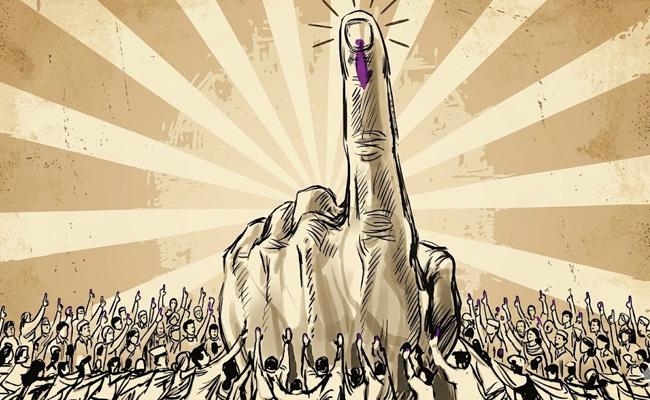
Representational image (GEMINI.AI)
In the world's largest democracy, elections are no longer purely won in the streets. They are, to a rapidly increasing degree, engineered in war rooms, staffed not by cadre workers chanting slogans but by data scientists, behavioral psychologists, and artificial inte ligence architects. The rise of professional election consultancies has fundamenta ly redefined what it means to run for office in India, transforming chaotic, cadre-based mobilizations into precision-guided operations that treat each voter not as a citizen but as a coordinate in a vast, continuously updated behavioral matrix.
This transformation did not happen overnight. For decades, Indian political parties depended on hierarchical networks of local leaders, district presidents, and grassroots workers who gauged public mood through intuition and personal relationships. That analog feedback loop is now almost entirely digitized, quantified, and replaced by predictive algorithms. The turning point arrived unmistakably with the 2014 General Elections, folowed by an even greater scaling up for the historic 2024 exercise. The vast, young, digita ly connected electorate was receptive to a new form of political communication, and modern campaign machinery seized that moment with unprecedented technological sophistication. 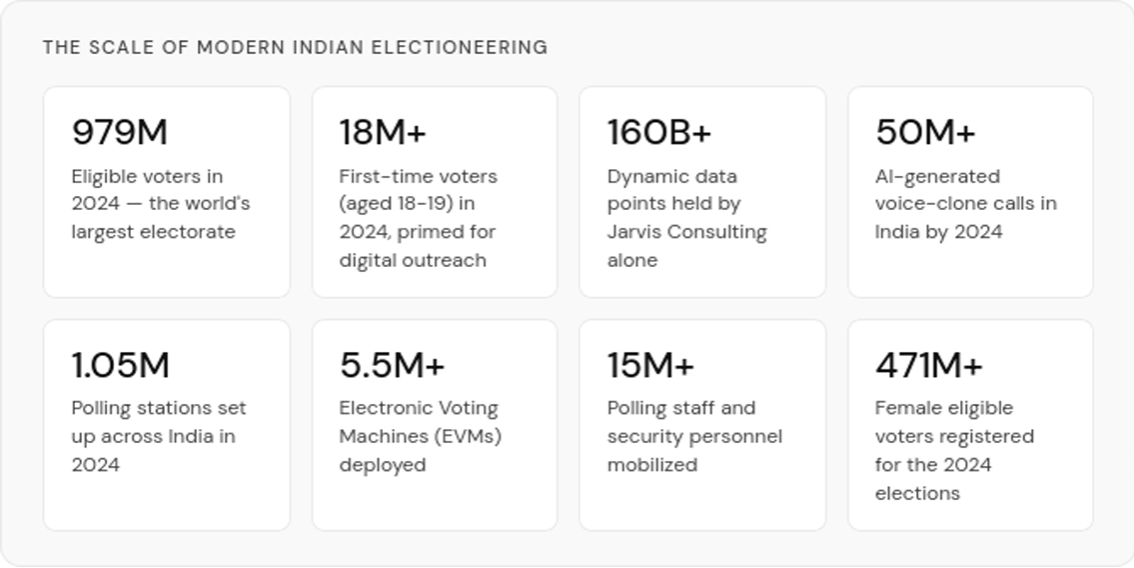
Initiatives like Chai pe Charcha, localized tea-sta l conversations broadcast and amplified across national digital networks, demonstrated early on that personalized interaction could be manufactured and scaled simultaneously. The lesson was absorbed industry-wide: customized storyteling, multimedia content, and hyper-personalized messaging could decisively influence electoral outcomes while bypassing traditional media gatekeepers entirely.
An industry matures — rapidly
The Cambridge Analytica scandal, while a cautionary global tale about data extraction and psychological profiling without consent, paradoxicaly accelerated India's indigenous consulting industry. It proved the sheer efficacy of micro-targeting, and prompted Indian firms to build similar, and in many respects superior, capabilities tailored to the extraordinary complexity of Indian caste, class, linguistic, and regional identities. Today's consultancies bear little resemblance to traditional campaign managers. They are multidisciplinary corporate conglomerates operating across data science, behavioral psychology, geographic information systems, digital warfare, and ground-level logistics simultaneously.
Inside the machine
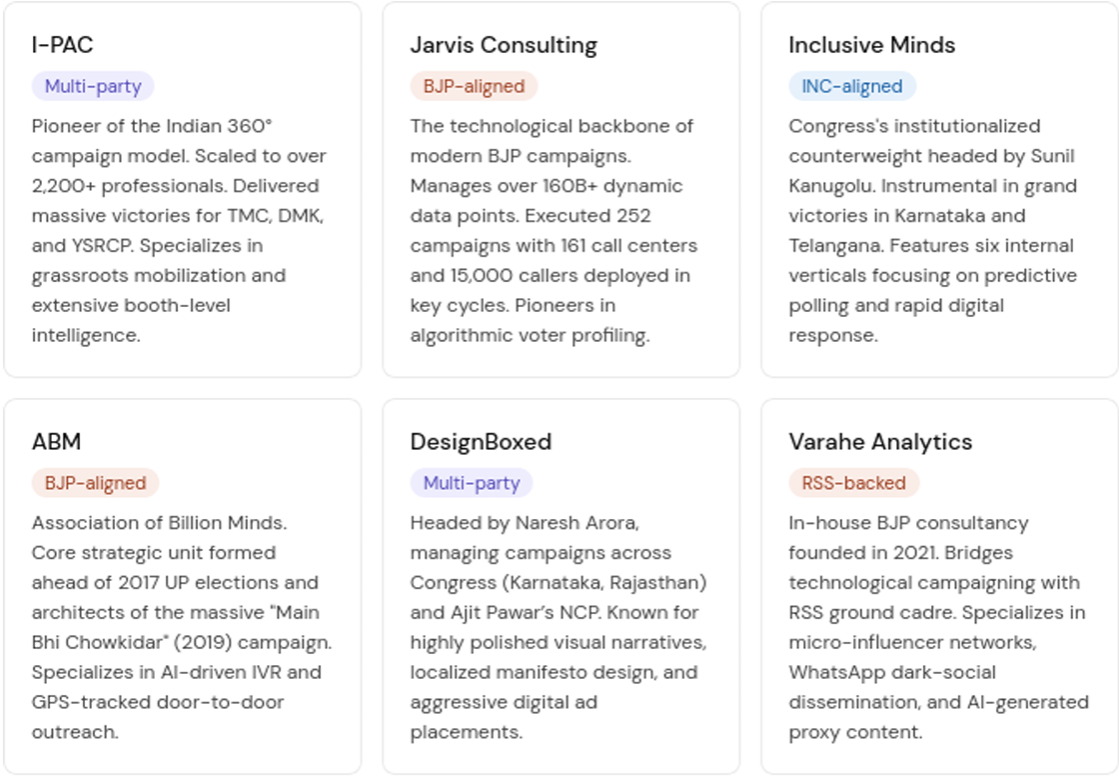
The architecture of a modern campaign managed by these firms is layered and highly compartmentalized. At the foundation lies booth-level data management, the mapping of entire constituencies down to individual po ling stations, identifying strongholds, weak zones, and swing areas with algorithmic precision. Firms like Jarvis Consulting have built proprietary mobile applications that booth heads use to log every door-to-door canvassing interaction in real time, feeding sentiment directly back into a central command database. Jarvis reportedly operated more than 161 dedicated cal centers during critical election cycles, processing mi lions of ca ls for granular demographic mapping.
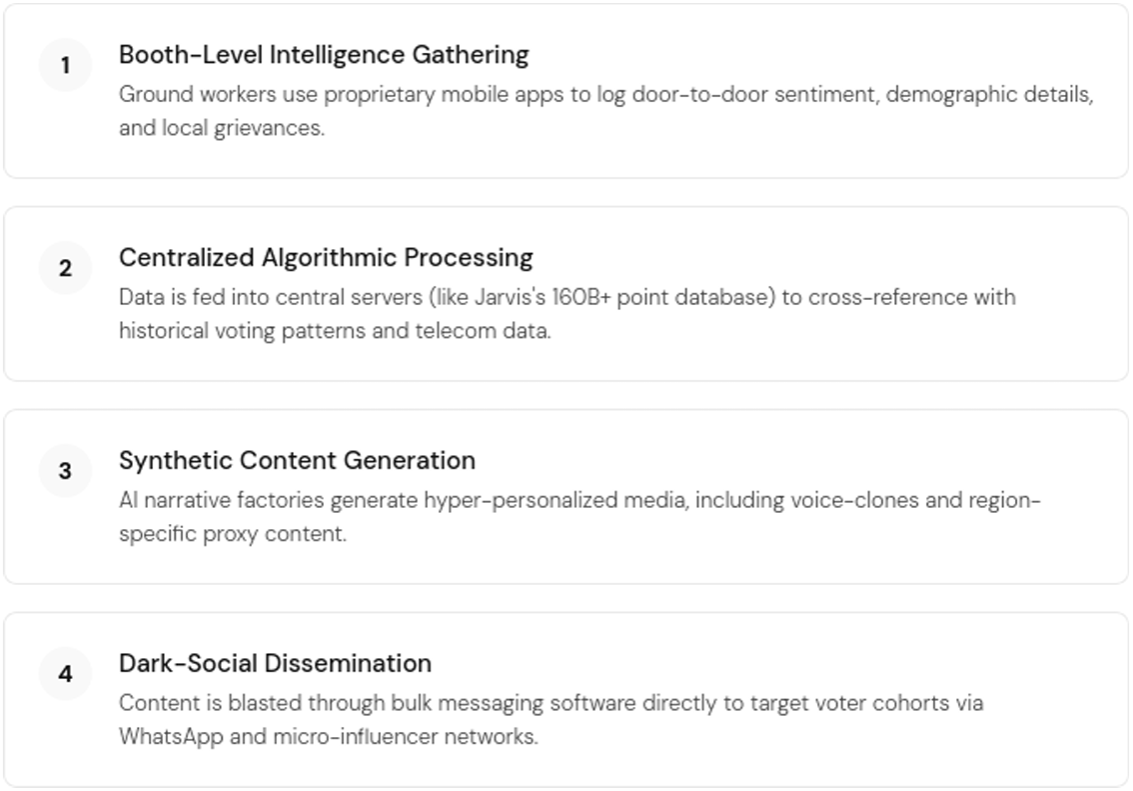
Parallel to this ground operation runs a sophisticated digital battle. Consultancies maintain secured "digital war rooms" running 24-hour sentiment monitoring, rapid-response counters to opposition claims, and algorithmic content distribution across WhatsApp, YouTube, and Instagram. WhatsApp campaigns form the backbone of grassroots digital communication, bulk messaging software, personalized AI-generated video clips, and localized broadcast channels a low a campaign to mobilize milions of supporters almost instantaneously. Varahe Analytics, the RSS-backed in-house consulting arm of the BJP, has taken this a step further: investigative reports have aleged its involvement in networks of proxy Instagram pages such as "Paltu Paltan" using young actors to generate AI-manipulated satirical content targeting opposition figures at massive scale.
"India is an intricate puzzle of localized castes, unique languages, and hyperlocal emotional issues. What works in Gujarat wil almost certainly fail in Tamil Nadu."
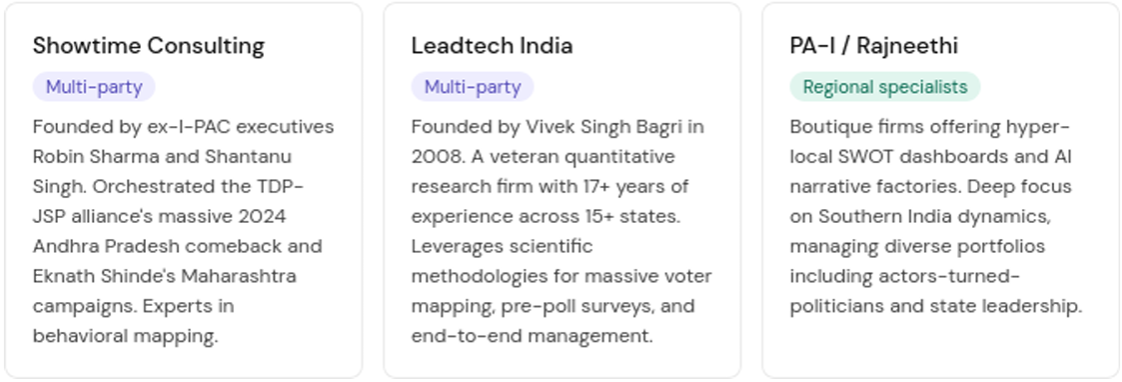
That observation, central to the philosophy of Political Analytics India (PA-I), a boutique regional f irm founded by former I-PAC executive Niranjan Ramesh Babu, underscores a growing fracture in the industry. While national giants like I-PAC and Jarvis operate at industrial scale, sma ler, cultura ly fluent regional firms are carving highly lucrative niches. PA-I has managed campaigns for figures as diverse as actor-turned-politician Kamal Haasan, BJP's Tamil Nadu state president K. Annamalai, and senior AIADMK and DMK leaders simultaneously, conducting constituency-specific SWOT analyses and integrating historical result data with booth-level intelligence.
The dangers hidden in the data
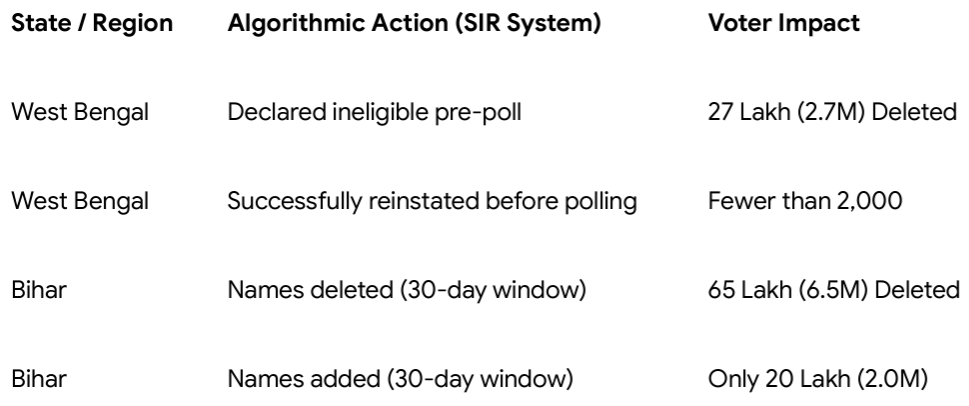
The same technological precision that makes consultancies devastatingly effective at voter outreach has surfaced some of the most alarming democratic crises in recent Indian electoral history. The 2025–2026 state election cycle exposed the perilous edge of data-driven governance through the "purging ro ls" controversy. The Election Commission of India introduced a new algorithmic process the Systematic Identification of Voters (SIR) designed to clean electoral ro ls. The results were catastrophic in scale.
Controversy — Voter Rol Purge Crisis, 2025–26
In West Bengal, 27 lakh (2.7 milion) voters were declared ineligible on the eve of pols. In Bihar, 65 lakh names were deleted against only 20 lakh additions in a single 30-day window. Fewer than 2,000 electors in West Bengal were successfuly reinstated before poling day. The Supreme Court intervened after the TMC, DMK, and LDF governments accused the SIR system of targeted voter suppression, relying on hasty algorithms that demanded excessive documentation disproportionately burdening minority communities.
Critics drew a direct line between the normalization of demographic categorization by private consultancies and the state's apparent ease with using similar algorithmic tools to categorize, and effectively disenfranchise, mi lions of voters. The boundary between administrative data hygiene and mass voter suppression, the Supreme Court acknowledged, had become dangerously thin.
A regulatory race against the algorithm
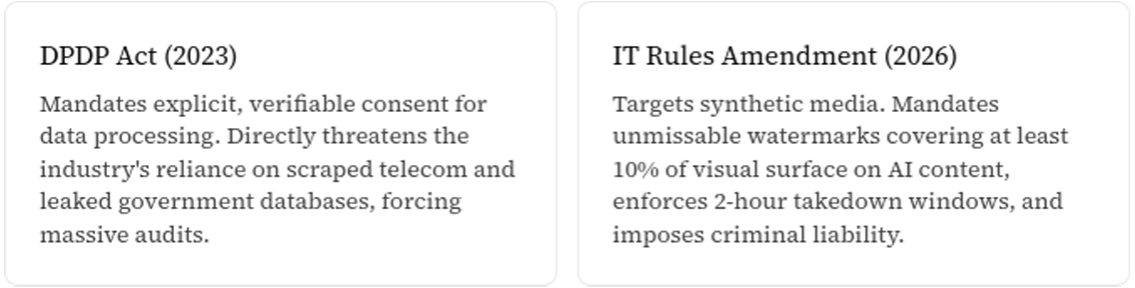
The legislative response has been rapid, if perpetualy reactive. The Digital Personal Data Protection (DPDP) Act of 2023, enforced heavily through 2025, now mandates explicit verifiable consent for data processing, a direct chalenge to an industry that previously scraped data indiscriminately from telecom providers, social media platforms, and leaked government databases. Firms like Jarvis, whose operational database exceeds 160 bilion dynamic data points accumulated over years, now face the prospect of massive audits and mandatory purging of improperly acquired records.
More dramaticaly, the explosion of synthetic media forced the government to enact the Information Technology (Intermediary Guidelines and Digital Media Ethics Code) Amendment Rules, 2026. By the 2024 election cycle, AI-generated voice-clone cals in India exceeded 50 milion. Research indicated that AI-generated fake news spreads more viraly than factual reporting. Deepfakes of Bolywood celebrities including Aamir Khan and Ranveer Singh were deployed, fabricating political endorsements. The IT Rules 2026 now mandate unmissable labeling on al syntheticaly generated content, watermarks covering at least 10% of the visual surface, and impose takedown windows as short as two hours for severe cases, with criminal liability under the Bharatiya Nyaya Sanhita for violations.
What comes next
The future trajectory of the industry points toward what researchers are caling "agentic AI" — autonomous systems capable not merely of executing human-designed campaigns but of independently strategizing, generating synthetic video messages from political leaders personaly addressing individual voters by name, referencing their specific crop yields, pending bank loans, and local grievances in real time. The physical-digital divide is dissolving further: AI-powered humanoid robots at poling events and realistic 3D holograms that may enable a single candidate to appear simultaneously at thousands of locations are no longer speculative proposals.
As AI technology commoditizes, the consultancy advantage is also democratizing downward. Regional and municipal parties, previously locked out by cost barriers, are increasingly engaging boutique firms like Rajneethi, which already operates across 18 states, to deploy national-grade micro-targeting tools at the constituency level. The result is an accelerating arms race in which electoral success increasingly belongs not to the party with the most resonant ideology, but to the consultancy with the most optimized algorithm.
India's democratic institutions, the Election Commission, the Supreme Court, and Parliament, now face an existential chalenge: ensuring that the extraordinary technological power assembled by these private firms to understand and persuade the voter does not ultimately supersede the sovereignty of the voter themselves. The mandate is stil formaly cast in the balot box. But increasingly, its architecture is drawn in a server room.
Sources: I-PAC, Inclusive Minds, Jarvis Consulting, ABM, Varahe Analytics, Leadtech India, DesignBoxed, Showtime Consulting, Political Analytics India, Rajneethi official records; Supreme Court proceedings; DPDP Act 2023; IT Rules 2026; Election Commission of India; Times of India; New Indian Express; Al Jazeera; The Hindu; BOOM Live investigative reports.