


When Chinese Yuan battles US Dollar, here's how your fuel, EMI suffer"

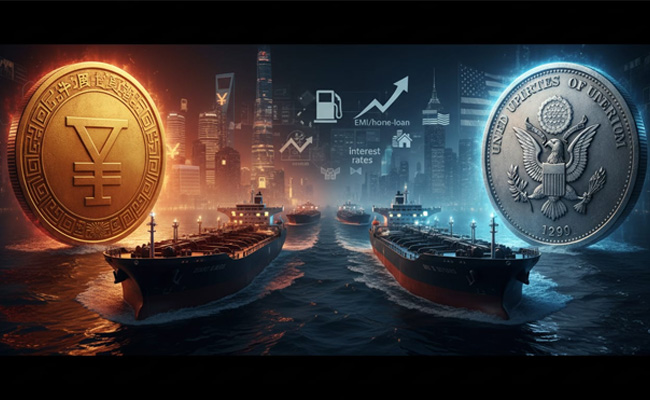
You fill petrol in your bike. You buy cooking gas. You pay your EMI. Have you ever thought that a war happening thousands of kilometres away in the Middle East can directly affect all three? It sounds dramatic, but it is completely true. Let us understand what is happening right now and why it matters to every one of us.
Iran controls one of the most important waterways in the world — the Strait of Hormuz. A huge amount of the world's oil passes through this narrow channel every single day. Even during the current tensions with the US and Israel, Iran is still exporting around 1.3 to 1.4 million barrels of oil every day. Most of it goes to China, where small refineries are quietly buying it — not in US dollars, but in Chinese yuan. This is a very important detail. Why? Because for decades, oil has always been bought and sold in US dollars. This arrangement has kept the dollar powerful and relevant globally.
Think of it this way. Imagine your colony has only one shopkeeper, and every household must buy their groceries from him. That shopkeeper will always remain powerful no matter what. America is that shopkeeper. Countries need dollars to buy oil, so they always need to hold dollars. This is why the dollar stays strong even when America itself is not doing great economically.
Now China is saying — why must we always use dollars? China has shifted nearly half of its trade to yuan. And Iran, which has some of the cheapest oil in the world, is openly questioning the US-backed alliances in the region. Together, these two are slowly trying to challenge the dollar's grip on global trade. This is no longer just a military conflict. It has become an oil war and a currency war at the same time.
Now what does all this mean for India?
India imports most of its oil. When global tensions rise, oil prices go up. India has to spend more dollars to buy that oil. More dollars going out means fewer dollars coming into India. This puts pressure on the Indian rupee and its value falls. A falling rupee is not just a number on a screen. It means petrol becomes costlier. Diesel becomes costlier. Anything that is imported — from electronics to medicines — becomes expensive. That cost lands directly in your pocket.
To protect the rupee, the Reserve Bank of India steps in. RBI sells dollars from its reserves to buy rupees back, which helps support the rupee's value. But here is the problem. When RBI sells dollars, it takes rupees out of the market, and suddenly there is less money flowing around for banks to lend. So RBI then buys government bonds from banks to push money back into the system.
Here is a simple example. Suppose a bank is holding a government bond worth ₹100. RBI buys that bond and gives the bank ₹100 in cash. Now the bank has cash to lend to people and businesses again. This balancing act goes on continuously behind the scenes.
But this juggling cannot go on forever. There is a limit to India's dollar reserves. If the situation does not improve, the rupee may fall further. And if RBI tries to stop the fall by raising interest rates, your home loan EMI goes up, businesses find it expensive to borrow, and the economy slows down. It is a difficult situation with no easy answer.
There is one more option RBI can use — limiting how much money investors and companies send abroad. This is called capital control. It is like telling people in your house — do not spend money outside, spend it here only. It helps reduce the outflow of dollars. But it also sends a very bad signal. Foreign investors may think India is in serious trouble and stop bringing money in. So this step is used only in extreme situations.
Right now, the war situation is still evolving. No one can predict exactly how things will turn out. Will oil prices stabilise? Will the dollar and yuan clash openly? Will Iran escalate further? These are all open questions.
What experts call "black swan" events — meaning big, unexpected shocks that no one saw coming — are happening more and more frequently in today's world. The 2008 financial crisis was one. COVID was one. This Middle East situation could become one too.
The message for all of us is simple. The world is deeply connected today. A missile fired in the Gulf can increase the price of your dal and petrol within weeks. Staying informed is not just for economists and analysts. It is for everyone who earns, spends, and dreams of a better life.
(Girish Linganna is an award-winning science communicator and a Defence, Aerospace & Geopolitical Analyst. He is the Managing Director of ADD Engineering Components India Pvt. Ltd., a subsidiary of ADD Engineering GmbH, Germany.)
Disclaimer: The views and opinions expressed in this article are solely those of the author. They do not necessarily reflect the views, policies, or position of the publication, its editors, or its management. The publication is not responsible for the accuracy of any information, statements, or opinions presented in this piece.